Stories
Japan Sets Sights On Mars Moon Mission To Unravel Red Planet Secrets

N
News18•19-10-2026, 16:50
Japan Sets Sights On Mars Moon Mission To Unravel Red Planet Secrets
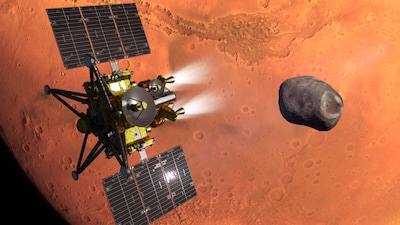
- •Japan is launching the Martian Moons eXploration mission on October 20 to collect soil and rock samples from Phobos, a moon of Mars.
- •Led by JAXA, the spacecraft aims to bring at least 10 grams of material back to Earth by 2031, potentially making Japan the first country to achieve this feat.
- •The mission features a joint French and German rover named Idefix to study the surface and assist with sampling operations.
- •Scientists hope analyzing Phobos samples will solve the mystery of how Mars moons formed and provide clues about the early Solar System.
- •Previous Soviet and Russian attempts to explore Phobos, including Phobos 1, Phobos 2, and Phobos-Grunt, all failed due to technical and communication issues.
Key Questions Answered
Led by the Japan Aerospace Exploration Agency (JAXA), the Martian Moons eXploration (MMX) mission aims to collect at least 10 grams of soil and rock samples from Phobos, one of Mars's two moons, and return them to Earth.
The spacecraft is scheduled to launch on October 20, 2026, travel to Mars, spend about three years studying its moons, and bring the collected material back to Earth in 2031.
Russia's earlier efforts faced significant setbacks, as the Soviet Union's Phobos 1 and Phobos 2 missions failed in 1988 due to lost contact and communication failures, while the 2011 Phobos-Grunt mission became stranded in Earth orbit.