Stories
Inside Antarctica's Giant Ice Telescope Opening a New Window to the Universe
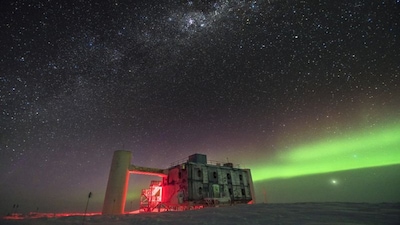
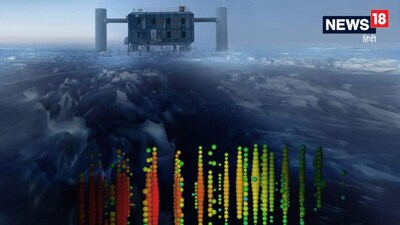
- •The IceCube Neutrino Observatory buried deep beneath the Antarctic ice uses 5,160 optical sensors across 86 vertical strings to detect elusive high-energy neutrinos.
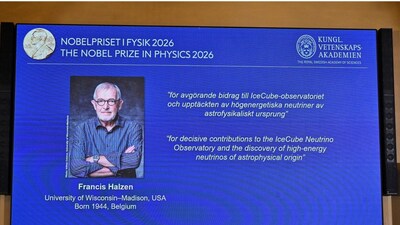
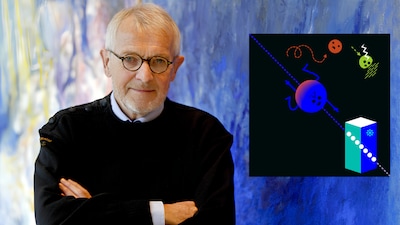
- •University of Wisconsin-Madison physicist Francis Halzen won the 2026 Nobel Prize in Physics for his foundational contributions to developing the neutrino observatory.
- •Neutrinos are nearly mass-free and uncharged particles that rarely interact with matter, producing a faint blue Cherenkov light when they collide with atomic nuclei in the ice.
- •Completed in 2011, IceCube filters through massive amounts of atmospheric data daily and has successfully mapped cosmic sources including a supermassive black hole and the Milky Way.
- •Scientists are already planning IceCube-Gen2, an expanded detector covering about eight cubic kilometres of ice to further advance neutrino astronomy.
Key Questions Answered
Francis Halzen, a physicist from the University of Wisconsin-Madison, won the 2026 Nobel Prize in Physics for his decisive contributions to the IceCube Neutrino Observatory and the discovery of high-energy neutrinos of astrophysical origin.
IceCube uses 5,160 digital optical modules buried between 1,450 and 2,450 metres deep in the Antarctic ice. When elusive neutrinos collide with atomic nuclei in the ice, they produce a faint blue flash known as Cherenkov light, which the sensors record to determine the particle's direction and energy.
Physicist Francis Halzen first presented the concept of using Antarctic ice as a neutrino observatory in 1988. Following experimental tests with AMANDA, the full IceCube construction project was completed in 2011.