Stories
Milky Way's Origin Solved: Formed from Thousands of Merging Galaxies, Black Holes & Dead Stars
- •The Milky Way galaxy was formed from the merger of thousands of smaller galaxies, some containing black holes and dead stars.
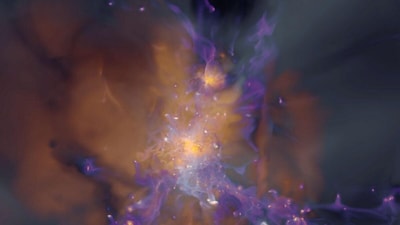
- •A 3-year simulation named 'MEGATRON', led by Professor Harley Katz at the University of Chicago, revealed this.
- •This simulation is the most detailed model to date, providing a clear picture of the early universe and Milky Way's evolution.
- •New data from the James Webb Space Telescope has further enhanced the understanding derived from the model.
- •The study also provided insights into bright galaxies without stars and the elusive Population III stars.
Key Questions Answered
The MEGATRON project is a highly detailed supercomputer simulation led by Harley Katz at the University of Chicago that took three continuous years to build. It models the early evolution of galaxies like the Milky Way during their first billion years.
The modern Milky Way formed from the merger of thousands of smaller galaxies over time. These precursor galaxies varied significantly, with some actively forming stars, others filled solely with gas, and many containing dead stars and black holes.
The constant iron level in extremely faint systems is caused by the violent explosions of ancient Population III stars that formed immediately after the Big Bang. Because these stars produced high amounts of iron, small galaxies lost this iron into space while larger ones retained it.