Stories
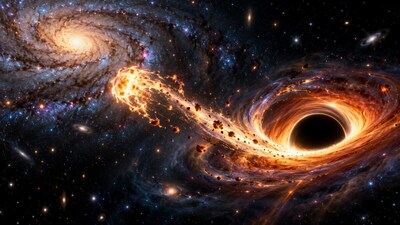
Black Holes Hunt Large Galaxies: Scientists Unravel Mystery of Cosmic Destruction.
- •Scientists have found the answer to the long-standing question of why supermassive black holes prove fatal for their own galaxies.
- •A direct connection has been established between the scarcity of stars in a galaxy and the presence of black holes.
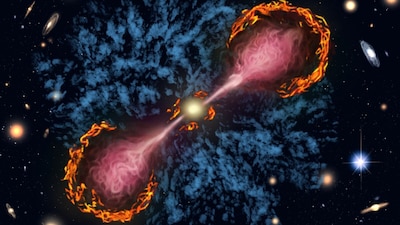
- •Plasma jets emitted by black holes reach the outer parts of galaxies, permanently halting the star formation process.
- •Supermassive black holes, despite their relatively small size compared to galaxies, have masses millions or billions of times that of the Sun.
- •The study, published in Astrophysical Journal Letters, reveals how black hole plasma jets disturb circumgalactic gas, preventing star birth.
Key Questions Answered
Active supermassive black holes emit powerful energy radiation and plasma jets from their centers that reach the outer edges of galaxies. These plasma jets disturb and heat the surrounding gas clouds, preventing the raw material from cooling and turning into new stars, which eventually causes the galaxy to die.
The circumgalactic medium consists of large clouds of gas and dust that surround all major galaxies, including the Milky Way. This medium serves as the essential raw material required for star formation, feeding gas into the galaxy when the star-making process accelerates.
While supermassive black holes have a massive scale—weighing millions or billions of times the mass of the Sun with a width equal to our solar system—their size remains extremely small compared to a massive galaxy containing over 100 billion stars. Despite this drastic size difference, their active energy output affects the environment across millions of light-years.