Stories
Terrifying Sight: Wandering Black Hole Brutally Shreds Living Star in Space
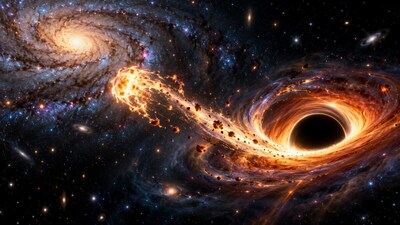
- •Astronomers discovered a massive wandering black hole more than 1,000 parsecs away from the center of its host galaxy, which tore a nearby star to shreds in an event named TDE 2023mfm.
- •The process of a star being destroyed by a black hole is called a Tidal Disruption Event, or TDE, which was first detected by the ZTF survey and subsequently studied using powerful telescopes like Hubble and Chandra.
- •Scientists believe wandering black holes are flung outward due to galaxy collisions or gravitational wave jolts, making them extremely difficult to locate unless they are actively consuming a star.
- •Data analysis of TDE 2023mfm revealed that the stellar debris reached temperatures of around 20,000 Kelvin, remaining extremely hot even a month after reaching peak brightness.
- •Radio telescopes recorded no signals from the event for nearly 991 days before detecting a very faint radio signal, leaving scientists puzzled about the gas density and flow dynamics.
Key Questions Answered
A Tidal Disruption Event happens when a star drifts too close to a black hole and is pulled apart and torn to shreds. The TDE 2023mfm event was initially detected by the ZTF survey and subsequently studied using powerful telescopes like Hubble, Swift, Chandra, Keck, and the VLA.
While most massive black holes reside at the center of their galaxies, some wander outward due to specific interactions. When two galaxies collide, interacting central black holes can produce powerful gravitational wave jolts that fling a black hole outward, or a three-body black hole interaction can eject one like a slingshot.
Using three different methods, scientists determined the mass of this wandering black hole to be 1 million to 10 million times that of the Sun. Through optical and ultraviolet ray studies, the temperature of the stellar debris was estimated to be around 20,000 Kelvin, remaining equally hot even a month after the brightness peaked.