Stories
James Webb Telescope Discovers Oldest Radio Burst Ever 10 Billion Light-Years Away
- •Scientists detected FRB 20240304B, the oldest and most distant Fast Radio Burst ever recorded, originating from 10 billion light-years away.
- •The James Webb Space Telescope successfully identified the faint host galaxy using its Near-Infrared Camera.
- •Analysis of the galaxy's light revealed it dates back to a time when the universe was only about 3 billion years old.
- •Researchers believe the signal may be linked to a magnetar, a neutron star with an extremely powerful magnetic field.
- •This groundbreaking discovery was published on October 8 in the journal Science.
Key Questions Answered
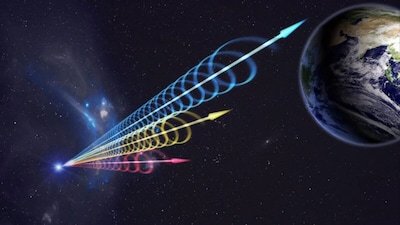
FRB 20240304B is a mysterious Fast Radio Burst emitted from a galaxy located approximately 10 billion light-years away. This signal dates back to a time when the universe was only about 3 billion years old, shattering previous distance records for such bursts.
After the MeerKAT radio telescope network detected the burst and determined its coordinates, initial ground-based observations revealed no visible galaxy due to its faintness. The research team then used the James Webb Space Telescope's Near-Infrared Camera to capture deep images, revealing an extremely faint host galaxy.
Researchers believe that this Fast Radio Burst may be related to a magnetar, which is a type of neutron star with an extremely powerful magnetic field formed after a massive star's explosion. However, the discovery does not definitively confirm whether all FRBs share the same origin.