Stories
Japan Launches Pioneering Mission to Retrieve Samples From Mars Moon

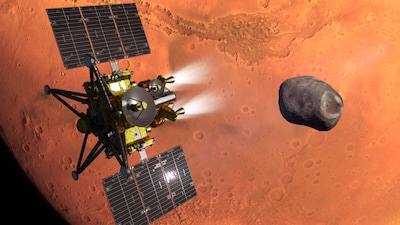
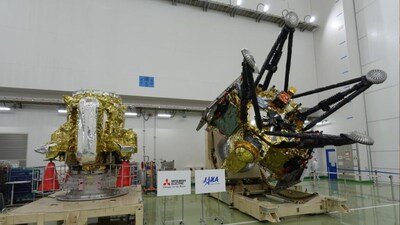
- •Japan successfully launched the unmanned Martian Moons eXploration probe aboard an H3 rocket from the Tanegashima Space Centre.
- •The historic mission aims to make Japan the first country to retrieve and bring back samples from Mars' moon Phobos.
- •Scientists hope analyzing at least 10 grams of surface material will reveal how the Martian moons formed and shed light on the origins of the Solar System.
- •The spacecraft will also observe Mars' smaller moon Deimos and assess if Phobos could serve as a natural space station for future crewed missions.
- •The international project involves space agencies from the US and Europe, joining global efforts to explore Martian material.
Key Questions Answered
Japan's unmanned Martian Moons eXploration (MMX) probe aims to collect at least 10 grams of surface material from Mars' moon Phobos and bring it back to Earth. If successful, this pioneering mission will make Japan the first country to retrieve samples from a Martian moon, helping scientists uncover how Phobos and Deimos were formed and shedding light on the early history of the Solar System.
The MMX spacecraft lifted off on Tuesday aboard an H3 rocket from the Tanegashima Space Centre at 4:41 am local time. Led by the Japan Aerospace Exploration Agency (JAXA), the probe is expected to reach the Martian system around August of next year for its planned three-year mission in the region.
Scientists have two primary theories regarding the origins of Mars' moons: one suggests they emerged from debris after a massive celestial body collided with Mars, while the other proposes they are captured asteroids held by the planet's gravity. Determining their true origins through the MMX sample analysis could also help researchers understand how habitable environments arose on terrestrial planets.