Stories
Japan to Launch Historic Mission to Retrieve Samples from Martian Moon Phobos

- •Japan is launching a spacecraft on the world's first mission to bring back soil samples from Phobos, one of the moons of Mars.
- •The five-year journey utilizing the new H-3 rocket aims to uncover the origins of the Martian moons and shed light on solar system life.
- •The international mission includes contributions from NASA, the European Space Agency, and French and German space agencies.
- •A rover jointly developed by France and Germany will land on Phobos ahead of the spacecraft to survey the surface.
- •The mission plans to collect at least 10 grams of soil using both U.S. and Japanese sampling devices before returning to Earth in 2031.
Key Questions Answered
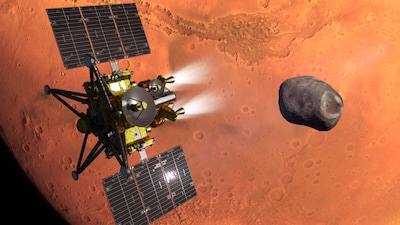
Led by the Japan Aerospace Exploration Agency, the MMX mission aims to be the first in history to bring back soil and rock samples from Phobos, one of Mars's moons. Scientists hope these samples will reveal how the Martian moons formed and shed light on the origins of the solar system.
JAXA is scheduled to launch the MMX spacecraft aboard an H3 rocket on October 20, 2026, from the Tanegashima Space Center. The ambitious mission is expected to take a total of five years, with the sample-return capsule scheduled to return to Earth in 2031.
After arriving at Mars and deploying a joint French-German rover named Idefix to explore the surface, the MMX spacecraft will attempt two landings to collect at least 10 grams of soil. It will use a U.S. pressurized gas device to lift surface dust and a Japanese coring tool to gather underground material from a depth of about 2 centimeters.