Stories
Lizzie: 345-Million-Year-Old Fossil Misidentified for Decades, Reshaping Evolution
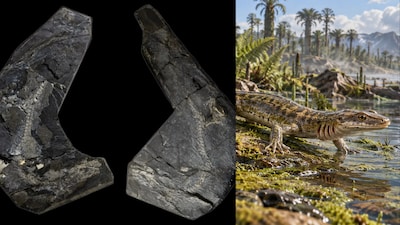
- •Scientists misidentified a 345-million-year-old fossil, nicknamed Lizzie, for over 30 years, initially classifying it as an early reptile.
- •Advanced X-ray scans revealed Lizzie had internal gills, a primitive skull, and a fish-like mouth, indicating it was an aquatic or amphibious stem tetrapod.
- •Discovered in 1984 in Scotland, Lizzie (Westlothiana lizziae) was initially thought to be one of the earliest amniotes due to its lizard-like appearance and four limbs.
- •The new findings challenge previous understandings of early vertebrate evolution and suggest that some ancient footprints with claw marks may need reassessment.
- •Modern technology, like X-ray imaging at the European Synchrotron Radiation Facility, allowed scientists to uncover Lizzie's hidden anatomy without damaging the fossil.
Key Questions Answered
Scientifically known as Westlothiana lizziae, Lizzie is a 345-million-year-old fossil discovered in 1984 at East Kirkton Quarry in West Lothian, Scotland. Initially classified as an early reptile due to its lizard-like body, advanced imaging has now shown it was actually an aquatic or amphibious stem tetrapod.
Lizzie's external features closely resembled early reptiles and other land-adapted animals, featuring four limbs and claw-like digits. However, because the fossil was crushed and its internal anatomy remained hidden, scientists could not examine its crucial internal structures for over 30 years.
Researchers used advanced X-ray imaging at the European Synchrotron Radiation Facility in Grenoble, France, to examine the specimen without damaging it. The scans uncovered internal gills, a primitive skull, and a fish-like mouth containing thousands of tiny teeth, proving it was a primitive aquatic animal.