Stories
Astronomers Reveal Surprising True Colours of White Dwarf Stars
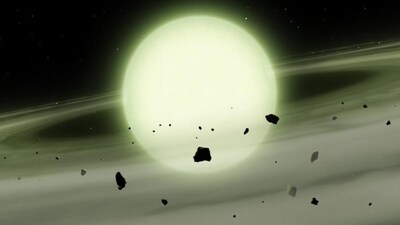
- •A new study led by researchers at the University of Warwick reveals that white dwarf stars can appear in unusual colours including green, pink, purple, yellow, and cyan.
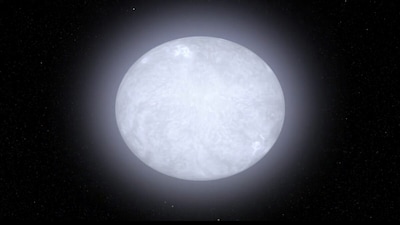
- •White dwarfs are dense stellar remnants roughly the size of Earth, left behind when stars like the Sun exhaust their nuclear fuel.
- •Scientists discovered stars like WD J1330+6435, which appears green due to its helium-rich atmosphere absorbing specific light wavelengths, and WDJ0902+2010, which appears pink.
- •Because white dwarfs are too distant to view with the naked eye, researchers determine their true colours by analyzing their light spectra and applying models of human vision.
- •Out of 151 examined white dwarfs, five displayed atypical hues, suggesting that roughly one in 30 white dwarfs may possess an unusual colour depending on temperature, density, and chemical composition.
Key Questions Answered
The unique hues of white dwarf stars depend on their temperature, atmospheric density, and chemical composition. For example, a helium-rich atmosphere absorbing specific wavelengths can give a star a green appearance, while carbon molecules absorbing blue, green, and yellow light can make a star look pink.
Because white dwarfs are too distant to resolve with the naked eye, astronomers analyze their light spectra to measure emission across different wavelengths. They then process this spectral data through human colour vision models to calculate the star's actual appearance from nearby.
No, most white dwarfs appear white rather than blue or other unusual hues. A study of white dwarfs within 65 light-years of Earth found that only about one in 30 possesses an atypical colour, with the rest matching a median temperature of around 6,800 kelvin corresponding to white light.