Stories
MIT-led astronomers discover a rare cosmic feeding where a star slowly consumes a brown dwarf
- •Astronomers have observed a unique system named ZTF J0440+2325 located 300 light-years from Earth.
- •A small red dwarf is slowly pulling material from a nearby brown dwarf in an extremely close 86.65-minute orbit.
- •This is the first recorded instance of a low-mass star actively accreting material from another low-mass object.
- •The brown dwarf loses material at a slow rate of about one hundred-thousandth of Earth's mass annually, allowing the process to continue for ages.
- •Material striking the red dwarf creates a moving hot spot that produces a mysterious triangular brightness signal detected by researchers.
Key Questions Answered
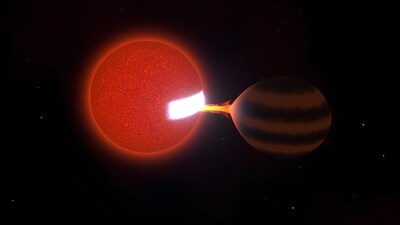
The ZTF J0440+2325 system consists of a low-mass red dwarf star and a brown dwarf located about 300 light-years from Earth. The two objects orbit each other every 86.65 minutes in an orbit small enough to fit within the diameter of the Sun.
Because the brown dwarf orbits extremely close to the red dwarf, material is pulled away from it through a process known as accretion. This stripped material forms a stream that falls directly onto the surface of the red dwarf at very high speeds.
As material from the brown dwarf strikes the red dwarf, it creates an extremely hot region on the star's surface. As the objects orbit each other, this moving hot spot produces distinctive triangular changes in brightness that were detected by the Zwicky Transient Facility.