Stories
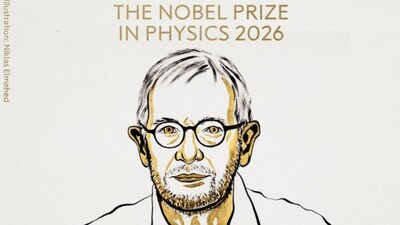
Nobel Prize 2026: Francis Halzen Awarded For IceCube Neutrino Research
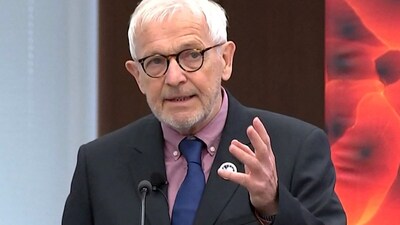
- •Renowned American physicist Francis Halzen has been awarded the 2026 Nobel Prize in Physics.
- •The honor recognizes his major contribution to the construction of the IceCube Neutrino Observatory deep within Antarctic ice.
- •Halzen first proposed the groundbreaking idea of using South Pole ice depths to detect elusive neutrino particles back in 1988.
- •His research has opened up a revolutionary new paradigm of astronomy, allowing scientists to trace the origin of powerful cosmic particles.
Key Questions Answered
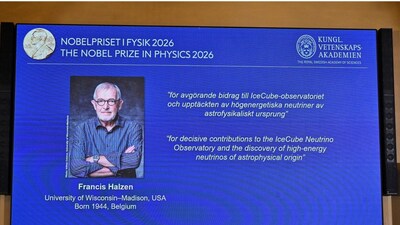
American physicist Francis Halzen has been awarded the 2026 Nobel Prize in Physics for his major contribution to the construction of the IceCube Neutrino Observatory in Antarctica and his rare achievement in detecting space-origin high-energy neutrino particles.
The IceCube Neutrino Observatory is a giant telescope comprising thousands of light sensors embedded deep within a cubic kilometer of Antarctic ice. When a neutrino particle rarely collides with an atomic nucleus, it creates a small beam of light that these buried sensors detect to gather cosmic information.
Neutrinos are called ghost particles because they are extremely delicate, electrically neutral, and barely interact with any other matter, allowing billions to pass through Earth and our bodies every second. They are immensely useful because they travel directly from billions of light-years away without changing direction, acting as messengers that carry complete information about violent cosmic environments.