Stories
Testing the Bambu Lab A2L 3D Printer: My Firsthand Experience and Review
M
Moneycontrol•18-10-2026, 16:20
Testing the Bambu Lab A2L 3D Printer: My Firsthand Experience and Review
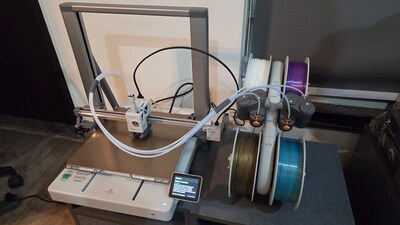
- •The Bambu Lab A2L offers a large build volume of 330 × 320 × 325 mm, giving home users more space to create custom decor and functional items.
- •Setup takes under an hour with automated bed levelling, clear touchscreen guidance, and a straightforward assembly process.
- •The printer supports PLA, PETG, and TPU materials, but lacks an enclosure and cannot effectively print styrene-based plastics like ABS.
- •Multicolour printing is supported via the AMS Lite system, though it can increase print time and result in material waste due to purging.
- •Bambu Studio and the MakerWorld ecosystem provide easy access to free models and powerful design customization tools for beginners.
Key Questions Answered
The Bambu Lab A2L features a build volume of 330 × 320 × 325 mm, providing 105% more printable space than standard 256 mm-class desktop printers, and utilizes a bedslinger design where the build plate moves back and forth along the Y-axis.
The A2L is equipped with a closed-loop servo extruder that detects filament grinding, clogs, and air printing, alongside a nozzle-clumping detector, filament run-out detection, tangled spool detection, and adaptive vibration compensation to safeguard long print jobs.
The printer supports materials like PLA, PETG, and TPU with temperatures up to 300 degrees Celsius, but it cannot print styrene-based plastics such as ABS because it lacks an enclosed chamber.