Stories
Wired vs. Wireless Security Cameras: Which is Best for Your Home?
N
News18•21-09-2026, 17:00
Wired vs. Wireless Security Cameras: Which is Best for Your Home?
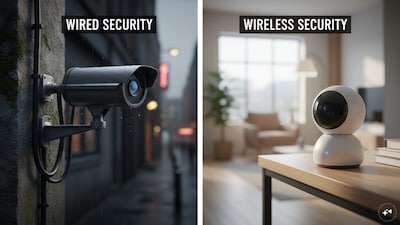
- •Wired cameras offer continuous power and are ideal for fixed locations like entrances, driveways, and permanent installations.
- •Wireless cameras provide easier installation and flexibility, suitable for gardens, balconies, or temporary monitoring.
- •A key distinction: 'wireless' connectivity (Wi-Fi) doesn't always mean 'wire-free' power; many Wi-Fi cameras still need a power cable.
- •Wired cameras excel in continuous recording and reliability where power is available, while wireless cameras are better for locations without easy power access.
- •The best solution for many homes might be a combination of both wired and wireless cameras to cover different needs and locations.
Key Questions Answered
For continuous power, wired cameras generally have an advantage because they do not rely on battery charge levels. However, overall reliability also depends on network connectivity, installation quality, and the specific camera model.
Not always, as some wireless cameras still require a power adapter. A genuinely wire-free camera normally uses a battery, solar power, or another independent power source, such as the eufy SoloCam S220 which combines a rechargeable battery with an integrated solar panel.
Yes, a camera can use Wi-Fi to transmit footage while still requiring a continuous power cable. For example, the Kasa KC420WS communicates through 2.4GHz Wi-Fi but receives its power through a 5V DC power adapter.