Stories
Solar Storm Alert 2026: Dual Eruptions Race Toward Earth
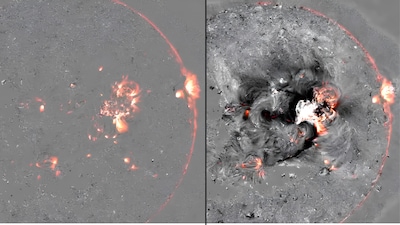
- •NOAA issued a geomagnetic storm watch following two coronal mass ejections that left the Sun on October 7 and 8, 2026.
- •Scientists reported that the faster second eruption caught up with and merged with the first cloud during its journey to Earth.
- •Geomagnetic activity reached strong G3 levels on October 10, with further G1 to G2 disturbances expected on October 11.
- •The solar storm has the potential to interfere with satellite operations, GPS navigation, radio communications, and power-grid systems.
- •Auroras may be visible farther from polar regions, though visibility from lower latitudes like India remains uncertain.
Key Questions Answered
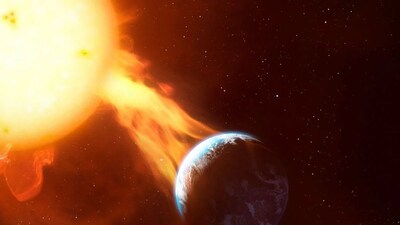
The US National Oceanic and Atmospheric Administration (NOAA) issued a geomagnetic storm watch after two coronal mass ejections (CMEs) left the Sun on October 7 and October 8, 2026. Forecasters expected the faster second eruption to catch up with and merge with the first one on its journey toward Earth.
A coronal mass ejection arrived at Earth on October 10, 2026, with its signature detected in the solar wind at 14:34 UTC. Geomagnetic activity subsequently reached G3, or strong storm levels, on that same day.
Geomagnetic storms can interfere with satellite operations, radio communications, and navigation signals while increasing atmospheric drag on lower-altitude satellites. Strong disturbances can also disrupt power-grid operations, especially in regions vulnerable to induced currents.