Stories
Scientists Develop Super Ice 10 Times Stronger Than Normal Ice with World War II Roots
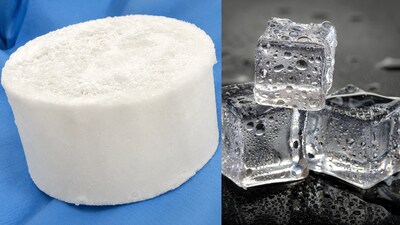
- •Researchers at the Hebrew University of Jerusalem have developed BioPykrete, a new type of ice that is about 10 times stronger than ordinary ice under compression.
- •The breakthrough material combines ice with plant-based cellulose nanocrystals and a specially designed protein that acts as molecular glue.
- •Laboratory tests reveal that the material can absorb roughly 70 times more energy before breaking and has a compressive strength approaching that of concrete.
- •The research builds upon a concept from World War II when British inventor Geoffrey Pyke proposed Pykrete, a mixture of ice and wood pulp, for building aircraft carriers.
Key Questions Answered
BioPykrete is an experimental reinforced ice composite developed by researchers at the Hebrew University of Jerusalem. Laboratory tests reveal that it is about 10 times stronger under compression than ordinary ice and can absorb approximately 70 times more energy before breaking.
Researchers combined ice with plant-derived cellulose nanocrystals to form a supporting network, and introduced a specially designed protein called CBM3a-AFPIII that acts like molecular glue to connect the crystals to the ice. This microscopic structure slows the spread of cracks and allows the material to withstand greater pressure.
The development of BioPykrete builds on a concept proposed during the Second World War by British inventor Geoffrey Pyke, who suggested using Pykrete—a mixture of ice and wood pulp—to build a giant aircraft carrier.