Stories
Beyond Angkor: Discover Ancient Hindu Sanctuaries Across Southeast Asia
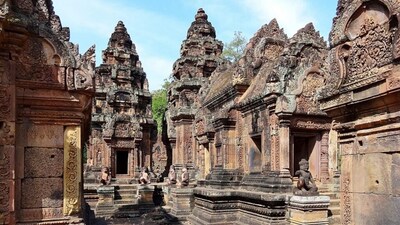
- •Explore Prasat Phanom Rung, a 10th-13th century sanctuary in Thailand dedicated to Shiva, engineered for solar alignment through 15 portals four times a year.
- •Visit My Son Sanctuary in Vietnam, a UNESCO site that was the spiritual heart of the Champa kingdom (4th-14th centuries), featuring tower-shrines honoring Shiva.
- •Discover Wat Phu in Laos, a UNESCO site developed from the 5th century, where the natural mountain peak resembles a Shiva lingam, showcasing early Indic cosmological planning.
- •Uncover Vat Nokor Bachey in Cambodia, an 11th-century Brahmanical shrine that transitioned into a Buddhist monastery, preserving Hindu stone lintels alongside Buddhist elements.
- •Marvel at Banteay Srei in Cambodia, a 10th-century temple known for its intricate pink sandstone carvings depicting scenes from the Ramayana and Mahabharata, consecrated by royal Brahmin scholar Yajnavaraha.
Key Questions Answered
Prasat Phanom Rung is a pink sandstone and laterite sanctuary built between the 10th and 13th centuries on an extinct volcano, dedicated to Shiva. It features precise engineering where the rising sun aligns through 15 consecutive sanctuary portals four times a year, and its pediments display narrative bas-reliefs like Nataraja and a reclining Vishnu.
My Son Sanctuary in Quang Nam, Vietnam, is a UNESCO World Heritage Site constructed using red fired brick joined without mortar along the Thu Bon River basin. It served as the spiritual and political heart of the Champa kingdom from the 4th to the 14th centuries, with tower-shrines honoring Shiva.
Vat Nokor Bachey was originally established as a Brahmanical shrine in the 11th century along the banks of the Mekong River in Cambodia. By the 15th century, it transitioned into an active Theravada Buddhist monastery while preserving its original Hindu stone lintels and guardian dvarapalas.