Stories
Shahed-136 vs Harop: Comparing Iran and Israel's Attack Drones
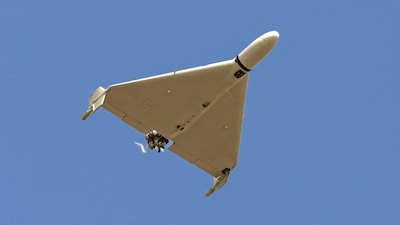
- •The Shahed-136 and Harop are both loitering munitions, but they are built for entirely different military doctrines and strategies.
- •Iran's Shahed-136 is a low-cost, long-range one-way attack drone designed to strike fixed infrastructure using pre-programmed coordinates.
- •Israel's Harop is a sophisticated loitering weapon featuring electro-optical sensors and human-in-the-loop control for precision strikes on high-value targets.
- •The Shahed-136 excels in range, heavier payload capacity, and affordability, enabling mass swarm attacks as seen in Ukraine.
- •The Indian Air Force operates the Harop, utilizing its nine-hour endurance and target-searching capabilities for suppression of enemy air defenses.
Key Questions Answered
The Iranian Shahed-136 is a low-cost, long-range one-way attack drone designed for fixed targets using programmed navigation. In contrast, Israel's Harop is a sophisticated loitering munition equipped with an electro-optical seeker, allowing an operator to search for targets, control the engagement, and abort attacks if necessary.
While the Shahed-136 uses satellite and inertial navigation to follow a pre-programmed route toward fixed infrastructure, the Harop features an electro-optical and infrared seeker. This allows the Harop to spend up to nine hours searching for moving or high-value targets while keeping a human operator in the loop for final authorization.
The Harop is operated by the Indian defense forces, making the comparison with the Shahed-136 particularly relevant from an Indian perspective. The Indian Air Force previously acquired the earlier Harpy system before subsequently acquiring the more advanced Harop.