Stories
Make in India at 12: Progress, Unfinished Business, and Future Challenges
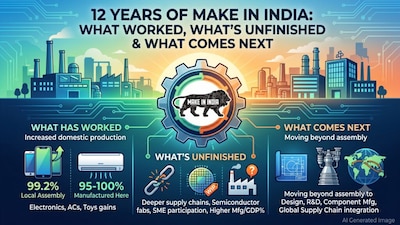
- •Make in India, launched in 2014, has significantly boosted manufacturing, particularly in electronics and air conditioners, shifting from import dependence to domestic production.
- •Key successes include 99.2% local assembly of mobile phones and 95-100% domestic manufacturing in the air-conditioning sector, with 70% component indigenization.
- •Despite gains, manufacturing's GDP contribution remains stagnant, highlighting the need to move beyond assembly to deeper value addition, component manufacturing, and semiconductor capabilities.
- •Future challenges involve attracting private investment amid global uncertainty, integrating smaller companies into supply chains, and enhancing research, design, and export competitiveness.
- •The initiative aims to transition from production-linked incentives to a self-sustaining, competitive manufacturing environment, focusing on domestic value addition and global supply chain integration.
Key Questions Answered
Over the 12 years since its launch in 2014, Make in India has helped drive visible gains in manufacturing, particularly across electronics, air conditioners, toys, and furniture. For instance, mobile phone assembly has reached 99.2% locally, and the air-conditioning sector has indigenously developed close to 70% of its component ecosystem.
The next phase faces hurdles such as moving beyond final assembly to build deeper domestic supply chains, advancing semiconductor capabilities, boosting research and design, and integrating smaller companies into the broader manufacturing ecosystem. Additionally, global uncertainty, geopolitical developments, and pressure on profit margins continue to impact private investment and export competitiveness.
Production-linked incentive (PLI) schemes were originally introduced to offset structural disadvantages like high energy, logistics, and financing costs. Industry leaders note that the objective is not a permanent subsidy but to eventually allow companies to operate competitively without incentives while policy focus shifts toward component localisation, PCBs, semiconductors, and design capabilities.