Stories
Nepal's Rs 415 Crore 'High-Risk' Mission to Defuse Himalayan 'Time Bomb', India to Benefit.
N
News18•03-10-2026, 18:58
Nepal's Rs 415 Crore 'High-Risk' Mission to Defuse Himalayan 'Time Bomb', India to Benefit.
- •Nepal is launching a Rs 415 crore 'high-risk' mission to prevent four dangerous glacial lakes in the Himalayas from bursting, bringing 3 key benefits to India.
- •The lakes, Thulagi, Lower Barun, Lumding Tsho, and Hongu II, are located at altitudes of 13,280 to 18,000 feet, posing a threat of massive devastation in Nepal and India's plains.
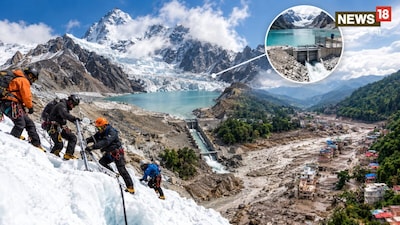
- •The mission involves draining water from the lakes using a controlled canal and gate system to reduce water levels by 10 feet, cutting flood risk by 70-80%.
- •India will benefit from averted flash floods in Bihar and UP, real-time data sharing with Nepal, and protection of billions worth of border infrastructure.
- •This 6-year project, funded by the Green Climate Fund, the UN, and the Government of Nepal, will also deploy sensors and an early warning system.
Key Questions Answered
Nepal is launching a mega 6-year project to safely drain billions of liters of water from four dangerous glacial lakes—Thulagi, Lower Barun, Lumding Tsho, and Hongu II—located between 13,280 and 18,000 feet to prevent catastrophic outbursts and flooding.
The mission will permanently avert sudden flash floods in Bihar and UP by reducing water levels, protect billions of rupees worth of border infrastructure like barrages and hydro projects, and allow real-time early warning data sharing with Indian authorities.
Nepal has previously and successfully lowered the water levels of Tsho Rolpa Lake in the central Himalayas in 2000 and Imja Lake near Mount Everest using the same drainage technique to protect downstream communities.