Stories
How DoT's Financial Fraud Risk Indicator Stops Scams
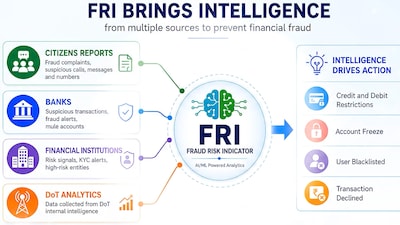
- •The Department of Telecommunications introduced the Financial Fraud Risk Indicator to help banks identify mobile numbers linked to financial fraud.
- •FRI combines intelligence from banks and DoT analytical systems to assess mobile numbers and flag potential risks before transactions are processed.
- •Institutions using FRI have already saved over Rs 5000 crore by declining suspicious transactions and generating early alerts.
- •FRI serves as a supplementary risk assessment tool that enhances existing fraud detection systems but does not guarantee total fraud prevention.
Key Questions Answered
The Financial Fraud Risk Indicator (FRI) is a risk assessment tool introduced by the Department of Telecommunications (DoT) to help banks and financial institutions identify mobile numbers potentially linked to financial fraud. By providing early telecom-related intelligence before transactions are processed, it enables stakeholders to take preventive measures and reduce the risk of financial losses.
FRI combines intelligence from banks, financial institutions, and DoT's analytical systems to evaluate the risk associated with specific mobile numbers. When a number is flagged, participating institutions can generate alerts, conduct additional checks, or decline suspicious transactions prior to completion.
Institutions utilizing the FRI system have successfully saved over Rs 5,000 crore by generating alerts and declining suspicious transactions. Specifically, cumulative blocked losses reached Rs 5,043.73 crore by August 2026, driven by the broader adoption of telecom-based risk signals across more than 1,600 connected entities.