Stories
Butterflies Fool Predators with Wing Illusions, New Study Reveals
M
Moneycontrol•01-10-2026, 11:43
Butterflies Fool Predators with Wing Illusions, New Study Reveals
- •A new study from the University of Exeter and the University of Essex, published in Nature, suggests butterflies use their wing patterns to create visual illusions that confuse predators.
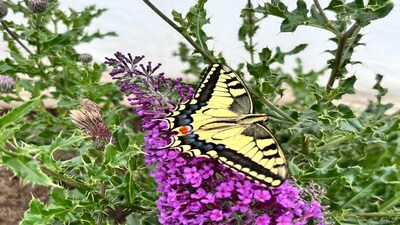
- •Butterfly wing patterns, such as stripes, can appear to move in directions that don't match the butterfly's actual flight path, creating "motion confusion" for predators.
- •This effect is similar to the barber-pole illusion, where rotating stripes create a misleading impression of motion, making it harder for predators to accurately track the butterfly.
- •Researchers filmed butterflies, analyzed 397 European species, and tested the effect on human participants in a touchscreen game, all confirming the motion-confusion phenomenon.
- •The findings suggest that conspicuous wing patterns, often thought to make butterflies more visible, may actually serve as a defense mechanism by making them harder to catch in flight.
Key Questions Answered
As butterflies fly, their wings constantly change shape and angle, causing patterns like stripes to shift and move in directions that do not match their actual flight path. This creates motion confusion, giving predators misleading information about the butterfly's true speed and direction.
Researchers filmed taking-off butterflies at 1,000 frames per second, analyzed 397 European butterfly species across 757 morphotypes, tested 100 human volunteers in a touchscreen catching game, and used computer-based evolution experiments to generate 57,600 wing patterns.
The study titled “Butterfly wing patterns in flight create powerful illusory motion cues” was published in Nature on September 30, 2026.