Stories
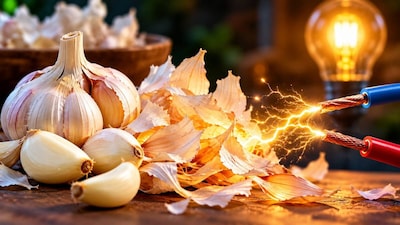
Indian Researchers Generate Electricity from Garlic Peels
N
News18•14-10-2026, 15:12
Indian Researchers Generate Electricity from Garlic Peels
- •Researchers Manas Tiwari and Deepak Bharti at the Malaviya National Institute of Technology in Jaipur have discovered a method to produce electricity from garlic peels.
- •The technology uses the triboelectric effect, generating electricity through friction between powdered garlic peels as a positive layer and a plastic sheet as a negative layer.
- •A single layer of garlic peels can generate about 210 volts, while two layers can increase the amount to about 400 volts, making it ideal for small electronic devices.
- •Experiments showed that even after storing garlic peels for six months and using them 200 times continuously, they successfully generated electricity.
- •This eco-friendly technology minimizes environmental impact and offers an effective way to utilize organic waste for powering small devices without chemical batteries.
Key Questions Answered
Researchers use the triboelectric effect, where powdered garlic peels serve as a positive layer and a plastic sheet acts as a negative layer. When these two surfaces rub against each other, electrons are exchanged to create electricity through a triboelectric nanogenerator.
Experiments show that a single layer of garlic peels can generate a voltage of about 210 volts. If two layers are used, this amount can increase to approximately 400 volts, making it very useful for operating small electronic devices.
This innovative technology was developed by Manas Tiwari and Deepak Bharti, who are researchers at the Malaviya National Institute of Technology in Jaipur.