Stories
Indian Researchers Discover Innovative Method to Generate Electricity from Garlic Peels
N
News18•12-10-2026, 14:45
Indian Researchers Discover Innovative Method to Generate Electricity from Garlic Peels
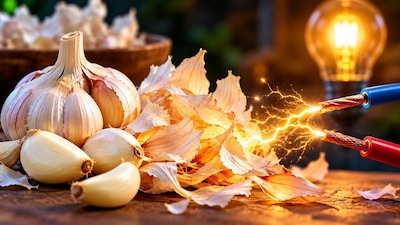
- •Researchers Manas Tiwari and Deepak Bharti from Malaviya National Institute of Technology, Jaipur, have developed a method to generate electricity from organic waste like garlic peels.
- •The technology utilizes the triboelectric effect, where friction between two different materials causes an exchange of electrons and generates an electrical charge.
- •Laboratory tests showed that a single layer of garlic peels can generate about 210 volts, while two layers can increase the amount to nearly 400 volts.
- •A triboelectric nanogenerator was created using powdered garlic peels as a positive layer and a plastic sheet as a negative layer to successfully operate small electronic devices and security sensors.
- •This eco-friendly energy innovation opens up new possibilities for reducing environmental damage while effectively utilizing huge amounts of organic household waste.
Key Questions Answered
Researchers utilize the triboelectric effect by combining powdered garlic peels as a positive layer and a plastic sheet as a negative layer, creating a triboelectric nanogenerator that produces electrical charges through friction when the layers rub together.
Tests indicate that a single layer of garlic peels can generate an electrical potential of about 210 volts, which increases to nearly 400 volts when two layers are used, though the current produced remains extremely low.
This innovative technology was developed by Manas Tiwari and Deepak Bharti, who are researchers at the Malaviya National Institute of Technology in Jaipur.