Stories
The Sovereign Siege: Asymmetric Warfare and the Battle for India Growth Engine
N
News18•12-10-2026, 20:30
The Sovereign Siege: Asymmetric Warfare and the Battle for India Growth Engine
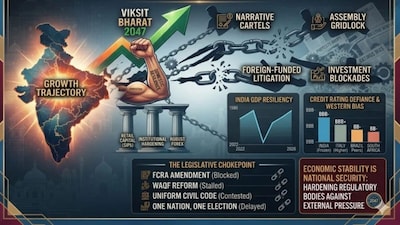
- •India faces a complex geopolitical paradox as its rapid economic growth to a five trillion dollar economy encounters coordinated domestic and international friction.
- •Systemic legislative gridlock, targeted protests, and stalled key reforms are deployed as asymmetric mechanisms to slow down India's national development.
- •Global sovereign credit rating agencies and foreign technology figures have historically applied pressure and biased metrics against India's economic resilience.
- •India's domestic regulatory maturation, robust ESG frameworks, and strong domestic retail investor ecosystem act as shock absorbers against external disruption.
- •Securing economic stability as a core element of national security is essential for India to achieve its Viksit Bharat 2047 development goals.
Key Questions Answered
Systemically blocked bills include the Foreign Contribution Regulation Amendment Bill 2026, Electoral Bills involving the Special Intensive Revision process, the Delimitation Act Implementation, the Waqf Board Amendment Bill, and the Corporate Laws Amendment Bill 2026.
Despite long keeping India static at BBB- due to weaponised policy disruptions, S&P upgraded India to BBB in August 2025 and Japan's JCR upgraded it to A- in September 2026, citing solid fiscal consolidation.
SEBI has formalized the ESG sector by approving 18 dedicated ESG Rating Providers like CRISIL and CareEdge, driving compliance under the BRSR framework to 88% and lowering the cost of capital by 20-30% for top-tier Indian firms.