Stories
Deendayal Upadhyaya's Integral Humanism: Uncovering the Overlooked Intellectual Roots
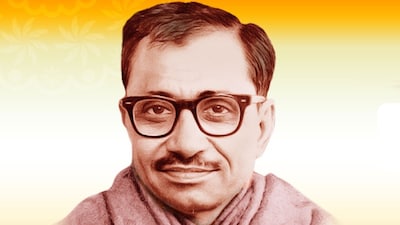
- •Deendayal Upadhyaya's Integral Humanism, the official ideology of the BJP, drew heavily from Badrishah Thulagharia's 1923 treatise, Daishik Shastra.
- •Mahatma Gandhi praised Daishik Shastra in 1923, calling it an "excellent book on oriental politics" and recommending it for national colleges.
- •The core concept of Chiti (collective consciousness) in Integral Humanism originates from Daishik Shastra, emphasizing national interest over individual.
- •Upadhyaya elaborated on Chiti as the "soul of the nation," a touchstone for cultural acceptance and national strength.
- •Daishik Shastra, meaning "science that guards and defends the nation," aimed to rekindle Bharat's national spirit by revealing ancient doctrines.
Key Questions Answered
Deendayal Upadhyaya propounded the philosophy of 'Integral Humanism' (Ekatma Manav Darshan) in 1965. It was first documented at the Jana Sangh’s Gwalior session in 1964 and formally accepted at the Vijayawada session in 1965. The philosophy drew heavily from the 1923 Hindi treatise Daishik Shastra by Badrishah Thulagharia.
Upadhyaya’s philosophy drew heavily upon Daishik Shastra, a 1923 Hindi treatise written by Badrishah Thulagharia, which translates broadly to 'The Science of Patriotism'. Thulagharia stated that the book emerged from ancient doctrines revealed to him through the grace of ascetic seer Mahatma Shri 108 Somabari Maharaj.
Mahatma Gandhi published a glowing review of Daishik Shastra in his daily Navjivan on February 8, 1923. He praised it as an excellent book on oriental politics in Hindi that highlighted the instability of Western politics, noting that those wanting to read the Bhagavad Gita and Upanishads through politics should treat it as a must-read textbook.