Stories
Indian Mathematician Mahesh Kakde Wins 2026 Ramanujan Prize
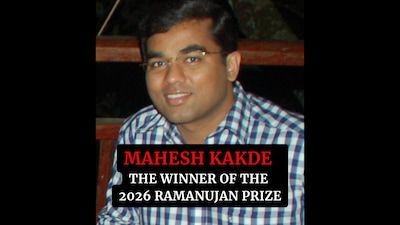
- •Mahesh Kakde, a mathematics professor at the Indian Institute of Science in Bengaluru, has won the prestigious 2026 Ramanujan Prize for Young Mathematicians from Developing Countries.
- •He was recognized for his groundbreaking work in algebraic number theory, particularly his contributions to noncommutative Iwasawa theory and the Gross-Stark and Brumer-Stark conjectures.
- •Born in Akola, Maharashtra, Kakde completed his PhD at the University of Cambridge and has previously held academic positions at Princeton University and King's College London.
- •His research has significant implications for Hilbert's 12th problem, helping reveal hidden structures and connections within mathematics.
- •Kakde's previous accolades include the 2022 Infosys Prize in Mathematical Sciences and being named among the Asian Scientist 100 in 2023.
Key Questions Answered
Indian mathematician Mahesh Kakde won the 2026 Ramanujan Prize for his contributions to algebraic number theory. Born in Akola, Maharashtra, in 1983, Kakde studied at the Indian Statistical Institute and completed his PhD at the University of Cambridge in 2008 before joining the Indian Institute of Science (IISc) as a professor in 2019.
Kakde was recognized for his fundamental results in noncommutative Iwasawa theory and his important contributions to the Gross-Stark and Brumer-Stark conjectures, which have implications for Hilbert's 12th problem.
The Ramanujan Prize for Young Mathematicians from Developing Countries is awarded annually by the ICTP and IMU to researchers under 45 years old who conduct outstanding research in a developing country. Established in 2005, the award includes a $10,000 cash prize and honors the legacy of Srinivasa Ramanujan.