Stories
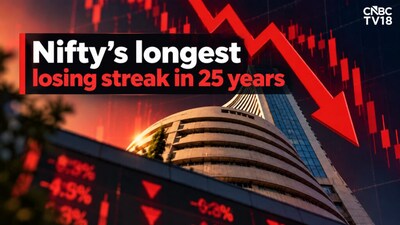
Indian Markets Face Longest Losing Streak Since 2001; Nifty Drops 3.1% in 8th Week

- •Indian equity benchmarks extended their losing run to an eighth straight week, marking the longest stretch of weekly declines in 25 years, surpassing the seven-week sell-off during the 2020 Covid-19 crash.
- •The Nifty 50 fell 0.88% to 22,421.95 and the BSE Sensex declined 0.79% to 71,909.70 on Thursday; for the week, the Nifty dropped 3.1% and the Sensex lost 2.7%.
- •Persistent selling by foreign investors, elevated US bond yields, a stronger dollar, and concerns over emerging-market assets contributed to the market pressure.
- •Domestic institutional investors provided strong support, infusing Rs 33,460 crore in the past week, while FIIs offloaded Rs 34,970 crore.
- •Rising crude oil prices, a weaker rupee, and higher global bond yields are key headwinds, with investors closely watching the RBI policy decision and upcoming corporate earnings.
Key Questions Answered
Persistent selling by foreign investors, elevated US bond yields, a stronger dollar, a weaker rupee crossing the Rs 96-per-dollar mark, and elevated crude oil prices hovering around $100 a barrel due to geopolitical tensions weighed heavily on Indian equities.
Foreign portfolio investors offloaded equities worth Rs 34,970 crore during the week and a substantial Rs 44,010 crore across September 2026, remaining net sellers for the 15th consecutive month. Conversely, domestic institutional investors emerged as strong net buyers, infusing Rs 33,460 crore during the week and Rs 76,030 crore throughout September to absorb market supply.
The eight-week losing streak is the longest stretch of weekly declines since 2001, when the Nifty recorded a nine-week losing streak, surpassing the seven-week sell-off seen during the Covid-19 crash in 2020. However, the current decline of about 9% remains significantly smaller than the roughly 22% fall in 2008 and the over 33% crash in 2020.